
light installations -  sound, video & interactive installations -  photography -  biography -  contact -  news
  Cielo di limoni   2003
Light installation
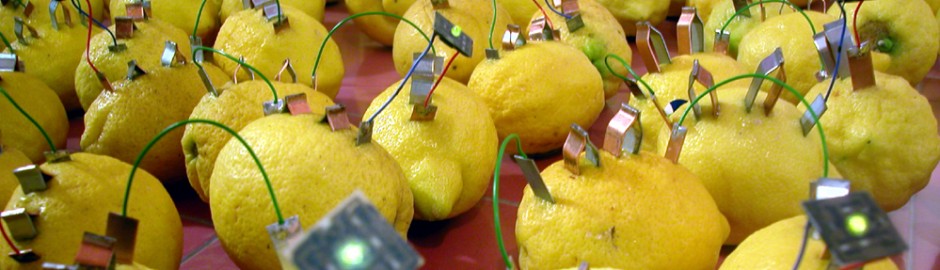
Hardware: 400 fresh lemons, LED and electronic circuits, zinc and copper sheets.
Dimensions: about 3 x 3 mt.

"Lemon sky". 400 lemons on the floor.
Using as combustible material the acid part of the lemons pierced with small metal sheets, I created Volta batterys that supplied with energy one hundred tiny Leds, one every 4 lemons, that flashed in half darkness for three or four days.
I imagined that the lemons during their "work" of withering and decomposing would give back the sun stored by the tree in his fruits during its productive phase in form of small flares.

It's a very simple and not permanent work I'm very engaged with.
I think it's fascinating that a fruit of nature through an electronic device can palpitate for some days. It seems the proof to me of our dipendence of environment, our tight and deep bond to nature .
Putting fuel into a car at a gas station this bond disappears, the action is aseptic, almost insignificant if not for an arched eyebrow because of the latest price increase.
Not even the strenght of a far remembrance of elementary school, of submerged and fossiled forests that return now in liquid form, stops the habit of consuming.
Beyond the captivating and simplicistic vision of nature, the respect for it, the energetic resources that are not renewable- including the sun, fortunately in long terms - this "Lemons Sky" reproposes a personal theme of my work: time. Six months of ripening, three or four days of life for the opera and then very short flashes of light, fragments, like snapshots of the passing by of time. Our little daily flares that slowly pour, sometimes without us. Implicit is the question if the flash has illuminated us or if we were simply absent at that moment.
I think of the opera of Alighiero Boetti: "Lampada annuale", the lamp that turns on only once in a year. To be there in that moment! To give oneself up in an artwork.

The electronic project
Let's look at the small flashing point: it's last summer's sun.
For some weeks we've studied how to use and improve the weak energy that results from chemical decomposing of metals and from the lemon juice.
Even working in a very simple way, Lemons Sky is realized with advanced electronic technologies, the electronic circuit is realized through SMD technology and the chips are the same used in computers and mobiles.
In one second the circuit stores up the biggest amount of possible energy, that is then discharged instantly with a flash of a LED's light. This little technological complexity is hidden on purpose to evidence the magic of small light points that shine with the smell of lemons. For a few days, as life.

Concept
I've been working for the last 15 years with the new technologies for audio, video and interactive installations. All electric or electronic instruments: audio systems, computers, video cameras, interfaces, monitors, video projectors, and so on, need electricity to work. Energy that almost always comes from the oil circle.
If we extend then our observation to how much this raw material conditions our life, the result is at least worrying. Unfortunately, after the fear in the 70's about wearing out of oil-wells, it seems that everybody has forgotten the precariousness of this unrenewable source.
Lemons Sky is an elementary installation that wants to propose a reflection on the energetic resources of our planet. In this phase of history where wars are fought in the urge of conquering energetic resources, it's imperative to remember that all presently used energetic resources derivate from the more or less slow accumulation of the only resource that is totally free and autonomous: the irradiation by the sun.
Wood of the trees, oil, or the juice of a fruit: these resources exist as transformation of the enormous energy given to us by the star Sun.

In poor countries the possibility of a technological evolution is strictly bound to the possibility to acceed to energy. In it's great simplicity, I think it's a great idea to produce radios fed by a little dinamo that is activated manually with the help of a handle.
Is it possible to imagine a computer with a handle? Maybe up to now there isn't a specific research about low-consume computers.
I think it's very important to testimony the experience of Bunker Roy in India. Together with the Berfoot College he helped poor populations of Rajasthan to install solar panels that were supposed to furnish energy to villages. The solar panels gave the opportunity to young people, that during the day were busy as sheperds, to go to night-school thanks to electric light, much more efficient than oil lamps. 


ennio bertrand.com - home - news - contact - search - credit